Barcelona is one of the busiest cruise homeports in the Mediterranean. In 2024 the port handled more than 3.6 million cruise passengers, making it the leading cruise gateway on the Iberian Peninsula and the third largest in Europe after Civitavecchia and Piraeus. Whether you are embarking for a Western Mediterranean sailing, disembarking after a transatlantic crossing, or simply transiting for a day ashore, understanding the geography of Port Vell and the practical transport options between Josep Tarradellas Barcelona–El Prat Airport, the city centre, and the individual cruise terminals is essential. This guide provides current, specific information on every realistic option, including pricing bands accurate for 2025–2026 travel.
Understanding the Layout of Barcelona Cruise Port
Barcelona's cruise port is not a single building but a complex of six operational cruise berths spread across roughly 3.2 kilometres of waterfront. The berths are administered by the Port de Barcelona authority and are divided into named terminals, each of which serves different cruise lines and ship sizes. Knowing which terminal your ship uses before departure day eliminates the risk of arriving at the wrong gate with luggage in tow.
Terminal A and Terminal B — World Trade Center (WTC) Zone
Terminals A and B sit at the northern end of the port, immediately adjacent to the World Trade Center Barcelona complex on the Moll de Barcelona pier. This location is the closest to Las Ramblas and the Gothic Quarter, approximately 1.2 kilometres on foot from the Columbus Monument at the foot of La Rambla. Both terminals are served by a common passenger hall with check-in desks, luggage drop facilities, and a small retail concession. Terminal A is the larger of the two and routinely handles vessels from MSC Cruises, Norwegian Cruise Line (NCL), and Costa Cruises. Terminal B occupies the same pier on the opposite side and typically serves smaller or second calls by the same operators. The walking distance from the nearest Metro station — Drassanes on Line 3 (green line) — to the WTC terminal entrance is approximately 700 metres.
Terminal C — Moll Adossat
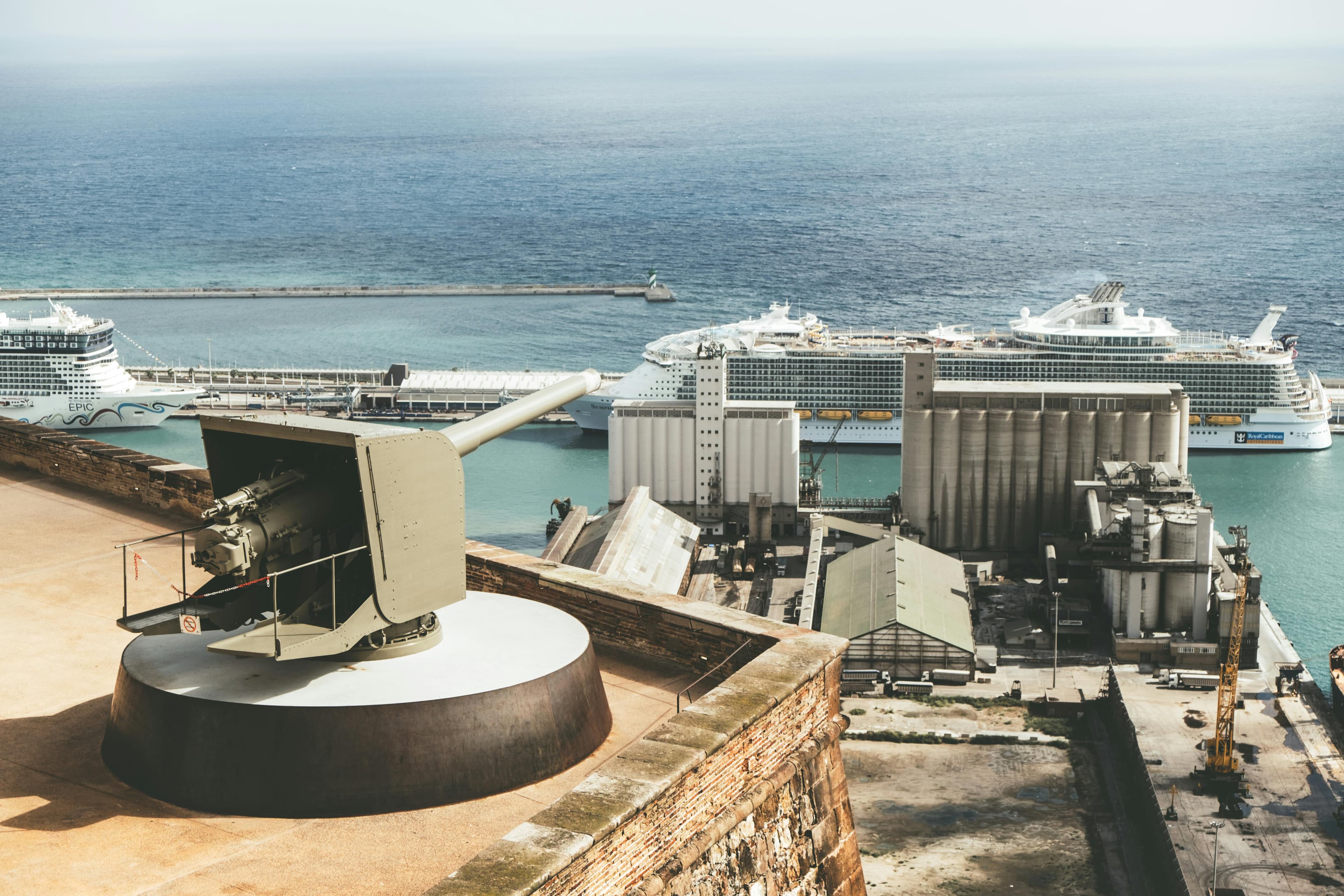
Terminal C is situated on the Moll Adossat breakwater, which extends into the harbour roughly 2.5 kilometres south-west of Las Ramblas. This distance means that Terminal C is not walkable from any Metro station; all passengers must use a shuttle, taxi, or private transfer. The terminal primarily serves Royal Caribbean International, which operates several Oasis- and Freedom-class ships from Barcelona, as well as occasional calls by Cunard. The terminal building was refurbished in 2022 and now includes a dedicated boarding hall with a capacity of approximately 4,000 passengers, climate-controlled waiting areas, and a luggage marshalling zone capable of staging containers for ships carrying more than 5,000 guests.
Terminal D — Moll Adossat
Terminal D sits directly alongside Terminal C on the same Moll Adossat breakwater, roughly 100 metres further south. It is the home berth for Celebrity Cruises and also receives calls from TUI Cruises. The port authority completed a passenger flow expansion here in 2023, adding a second security lane and an improved vehicle drop-off forecourt. The Carnival Corporation brands — AIDA Cruises, P&O Cruises (UK), and Carnival Cruise Line on European itineraries — also use Terminal D for summer sailings.
Terminals E and F — Moll de la Costa
Terminals E and F are the newest facilities, located at the far southern end of the port on the Moll de la Costa. They handle the largest contemporary vessels, including those of the Excel class, and serve as the primary berths for MSC Cruises' flagship ships during peak season. Distance from the city centre is approximately 4 kilometres by road. The same shuttle services that connect Terminals C and D to Las Ramblas also stop at Terminals E and F.
| Terminal | Location / Pier | Key Operators (2025) | Distance from Las Ramblas | Nearest Public Transport |
|---|---|---|---|---|
| A & B | Moll de Barcelona (WTC) | MSC Cruises, NCL, Costa | ~1.2 km | Metro L3 Drassanes (700 m) |
| C | Moll Adossat | Royal Caribbean, Cunard | ~2.5 km | Port shuttle or taxi |
| D | Moll Adossat | Celebrity Cruises, AIDA, TUI, P&O (UK) | ~2.5 km | Port shuttle or taxi |
| E & F | Moll de la Costa | MSC (Excel class), various | ~4 km | Port shuttle or taxi |
The Port Shuttle Bus — Free Connection Between Terminals and Las Ramblas
The Port de Barcelona operates a dedicated shuttle bus service, known internally as the portbus or cruise shuttle, that runs a circular loop between the Columbus Monument (Monument a Colom) at the foot of La Rambla and all Moll Adossat terminals including C, D, E, and F. As of the 2025 summer season the service is free of charge for cruise passengers; you will be asked to show a boarding pass or cruise card when boarding at the Columbus Monument stop. The buses run at intervals of approximately 20 minutes during peak embarkation and disembarkation hours (07:00–14:00 and 15:00–21:00) and approximately 30 minutes at other times. The single journey from Las Ramblas to Terminal C takes around 10 minutes; to Terminal D approximately 12 minutes; and to Terminals E and F around 18 minutes. Note that the shuttle does not stop at Terminals A and B because those are accessible on foot.
Passengers with large amounts of luggage should board the shuttle at the Columbus Monument stop rather than attempting to carry bags along the harbourfront promenade. Prams and mobility aids are accommodated; passengers using power wheelchairs are advised to confirm capacity when the shuttle arrives as the buses have limited low-floor space.
Getting from Barcelona Airport (BCN) to the Cruise Port
Josep Tarradellas Barcelona–El Prat Airport (IATA: BCN) is located approximately 14 kilometres south-west of the cruise port by road. There is no direct rail connection between BCN and the port terminals, which means all passengers face at least one mode change regardless of how they travel. The main options are: Aerobus express coach, city Metro with a transfer, taxi, and private transfer.
Aerobus — Fastest Public Coach Option
The Aerobus is a privately operated express coach service running non-stop between BCN airport's two terminals (T1 and T2) and Plaça de Catalunya in central Barcelona. As of 2025, fares are €7.75 per person for a single journey and €13.30 for a return, with tickets available from vending machines at each stop, from the driver, or via the Aerobus mobile app. The journey from T1 to Plaça de Catalunya takes approximately 35 minutes in normal traffic; from T2 it takes approximately 25 minutes. Services run every 5 to 10 minutes from approximately 05:00 to 01:00 daily.
Plaça de Catalunya is not the cruise port. Once at Plaça de Catalunya, cruise passengers must travel a further 1.5 kilometres to the port area. The most convenient continuation is Metro Line 3 (L3, green line) from Catalunya station southbound to Drassanes station (two stops, approximately 4 minutes) for Terminals A and B. For Terminals C, D, E, or F, passengers disembark the Aerobus at the earlier stop at Plaça d'Espanya and take a taxi to the Moll Adossat, or they continue to Catalunya and catch the port shuttle from Columbus Monument. The total door-to-terminal journey time using Aerobus plus Metro plus walking is typically 55–70 minutes from T1 during daylight hours.
Metro — Cheapest Option, Not Direct
Barcelona's Metro network does not currently serve the airport directly on a single line to the port. Metro Line 9 Sud (L9S, orange line) connects T1 and T2 to the Zona Universitària interchange, where passengers can change to Line 3. From Zona Universitària, Line 3 runs to Drassanes in approximately 14 minutes. A single Metro fare within the Barcelona metropolitan zone (Zone 1) was €2.55 in 2025; the airport supplement brings the total to €5.15 from either terminal. Journey time from T1 via L9S to Drassanes (with a change at Zona Universitària) is approximately 40–50 minutes, not including waiting times. This option is practical only for Terminals A and B. Passengers heading to Moll Adossat terminals with large luggage will find the Metro inconvenient because of the stairs and transfer.
Note on the L9 extension: the long-planned extension of Metro Line 9 directly into the city centre — which would have provided a one-seat ride from the airport to the port area — remains incomplete as of mid-2026. The section from Sagrera to the Zona Universitària hub has been under construction for over a decade; no confirmed opening date has been published by Transports Metropolitans de Barcelona (TMB) for the remaining central section.
Taxi from BCN Airport to Cruise Terminals
Official taxis from BCN airport operate under fixed-rate supplements regulated by the Àrea Metropolitana de Barcelona. As of 2025–2026 the supplementary airport surcharge is €4.30 regardless of destination. The metered fare from the airport to the WTC terminals (A and B) or to the Moll Adossat terminals (C and D) is typically in the range of €35–45 including the airport supplement and luggage, depending on traffic. Night tariff (21:00–07:00) and weekend/public holiday tariff (Tariff 2) add approximately 20–25% to the meter reading. Average journey time from T1 in normal daytime traffic is 25–35 minutes; during morning peak hours (07:30–09:30) this can increase to 50–60 minutes due to the Ronda Litoral ring road. All official Barcelona taxis are licensed and identifiable by their black and yellow livery; fares are always metered and a receipt is available on request.
Private Transfer — Door-to-Terminal Service
Private transfer operators offer pre-booked, fixed-price door-to-terminal journeys that are particularly popular with cruising passengers because of the luggage capacity and the certainty of price. Typical market pricing bands for a private transfer from BCN airport to any cruise terminal in 2025–2026 are:
- Standard saloon car (up to 3 passengers, 3 bags): €55–70 one-way
- Minivan / MPV (4–6 passengers, 6 bags): €70–90 one-way
- Large minibus (7–8 passengers, 8+ bags): €90–120 one-way
These prices are for the full vehicle, not per person, making the per-head cost competitive with taxis for groups of three or more. Reputable operators serving the Barcelona cruise market include World Global Travel's own ground transfer service (bookable at /contacts), as well as third-party providers such as Blacklane, Welcome Pickups, and Get Transfer. Operators should be selected on the basis of IATA or NTV accreditation, licensed local drivers, and a published cancellation policy that covers flight delays.
For travellers arriving the day before embarkation — which is strongly recommended for early morning sailings — the private transfer from airport to hotel and then hotel to port on embarkation day typically costs €55–90 for the airport leg and €35–55 for the hotel-to-port leg, depending on vehicle type and hotel location.
Getting from the City Centre to the Cruise Port
Travellers staying overnight in central Barcelona before or after their cruise have several convenient options to reach the port.
Metro Lines 3 and 4
Metro Line 3 (Drassanes station) serves Terminals A and B at the WTC. The station exit on the Rambla side is approximately 700 metres from the terminal entrance. Line 4 (Barceloneta station) provides access to the northern end of the port waterfront but does not bring passengers close to the cruise terminals on Moll Adossat. A single Zone 1 Metro fare is €2.55; a T-Casual 10-journey card costs €12.15 and is transferable between all Metro, bus, and tram services within Zone 1 (2025 TMB tariffs).
Taxi from City Centre Hotels
A taxi from a central hotel (Las Ramblas, Eixample, Gothic Quarter) to Terminals A and B typically costs €8–14. To Terminals C or D the fare rises to €12–18. Taxis are plentiful at major hotels and at designated rank points; ride-hailing apps including FreeNow and Cabify also operate licensed taxis in Barcelona and both allow pre-scheduling a pickup for embarkation morning.
Bus Lines 14 and D20
TMB bus line D20 (Diagonal bus) and bus 14 serve the Columbus Monument area and can be used as a slow but cheap alternative from the Eixample and Gràcia districts. Journey time from Passeig de Gràcia to Columbus Monument is approximately 20–25 minutes by bus. From Columbus Monument, passengers for Moll Adossat terminals use the free port shuttle as described above.
Embarkation Day — Practical Tips and Timing
Cruise embarkation in Barcelona typically opens between 11:00 and 14:00 depending on the cruise line and ship turnover. The port does not permit passengers to enter the terminal building before the boarding window opens, and there is limited covered waiting space outside. The following points will help make embarkation as smooth as possible.
Arrive with Pre-Tagged Luggage
All major cruise lines servicing Barcelona instruct passengers to attach luggage tags printed from their online check-in system before arrival. Porters at the Moll Adossat terminals collect large bags from the vehicle drop-off zone; guests do not need to carry bags beyond the drop-off point. Tags must be attached to the handles in a visible position; bags without tags are held for manual sorting, which can delay in-cabin delivery by two to four hours.
Recommended Arrival Window
Most cruise lines assign check-in time slots to manage terminal crowding. Arriving within your assigned slot reduces queuing at security and the check-in desk. As a general guide:
- Ships departing at 17:00–18:00: terminal typically opens at 11:00, peak boarding is 12:30–14:30
- Ships departing at 20:00–22:00: terminal typically opens at 14:00, peak boarding is 15:00–18:00
- Overnight departures: terminal typically opens at 16:00 or later
If your cruise line uses allocated check-in times (Royal Caribbean, MSC, Celebrity, NCL all do as of 2025), boarding outside your slot may result in being directed to a waiting area until your window opens.
Dining Before or After Check-In
The food options within the cruise terminals themselves are limited to vending machines and a small café. Passengers arriving early are advised to eat before entering the port complex. The Barceloneta neighbourhood — a 15-minute walk from Terminals A and B, or a 10-minute taxi from Terminals C and D — has numerous restaurants serving lunch until 15:30 and is an excellent option for a final meal before sailing. The Mercat de la Barceloneta (municipal market) is open until 14:00 on weekdays and stocks takeaway food, fruit, and cold drinks suitable for carrying aboard.
Security and Customs Checks
Barcelona cruise terminals use X-ray and walk-through metal detector screening consistent with ISPS Code requirements. Liquids in hand luggage are subject to the EU 100 ml / 1-litre bag rule for the purposes of port security, although individual cruise lines may also restrict alcohol or bottled water in carry-on bags under their own policies. Passengers are advised to check their cruise line's specific prohibited items list before arrival.
Getting from the Cruise Port to BCN Airport on Disembarkation Day
Disembarkation in Barcelona typically begins at 07:30 and must be complete by 10:30 for most ships. This creates a large simultaneous demand for taxis and transfers, and the port taxi queues on busy turnaround days can be 30–60 minutes long for passengers without pre-booked vehicles.
Pre-Booked Private Transfer — Strongly Recommended
For passengers with flights departing before 14:00, a pre-booked private transfer is the most reliable choice. The driver meets you in the terminal arrivals hall or at the designated pick-up point outside the terminal building, handles your luggage, and proceeds directly to the airport. Pricing is the same as the inbound journey (€55–70 for a saloon, €70–90 for a minivan). The drive from Moll Adossat to T1 typically takes 25–35 minutes; allow 30 minutes extra on busy summer mornings when the Ronda del Litoral ring road can experience congestion near the Mercabarna junction.
Port Taxi Queue
The Port de Barcelona maintains a regulated taxi rank at each terminal exit. Fares to the airport are metered plus the €4.30 airport supplement. On high-volume disembarkation days (Saturdays, Sundays, and major bank holidays during summer), queues at the Moll Adossat ranks have been documented at 45–90 minutes. The WTC taxi rank near Terminals A and B is smaller and faster but still subject to demand spikes. FreeNow and Cabify can dispatch a car more quickly on these days because their vehicles are not restricted to the fixed rank, though surge pricing may apply during peak demand windows.
Aerobus from Columbus Monument
Passengers without large luggage who disembark from Terminals A or B can walk or take the port shuttle to the Columbus Monument Aerobus stop and board directly. This option is impractical for passengers from Moll Adossat terminals with multiple bags. However, for solo travellers or couples with carry-on only, the Aerobus remains the fastest and most economical option: €7.75 single to either T1 or T2, departing every 5–10 minutes.
Multi-City Itineraries: Combining Barcelona with Other Mediterranean Ports
Many passengers on open-jaw itineraries fly into Barcelona and cruise to another embarkation point — Rome (Civitavecchia), Lisbon, or Athens (Piraeus) — or vice versa. For these travellers, luggage storage near the port is useful for the day of arrival or departure. The Barcelona-Sants and Barcelona-Passeig de Gràcia railway stations offer left-luggage lockers (consigna automàtica), as does Barcelona-El Prat Airport. The Port Vell area is served by two private luggage storage companies (Nannybag and Stasher) with locations within 400 metres of Columbus Monument; costs are approximately €6–9 per bag per day.
Rail connections from Barcelona are relevant for passengers continuing overland. RENFE AVE high-speed trains link Barcelona-Sants with Madrid Atocha (2 h 30 min, from €39), Valencia Joaquín Sorolla (1 h 35 min, from €29), and Paris Montparnasse via Perpignan (6 h 25 min, from €59 on Ouigo ES). The station is accessible by Metro L3 and L5 and is approximately 4 kilometres from the cruise port by taxi (€14–18).
Accessibility: Wheelchair and Mobility Aid Users
All Barcelona cruise terminals are legally required to comply with Spanish accessibility regulation RD 1544/2007 and EU Regulation 1177/2010 on passenger rights in maritime transport. Ground-level entry is available at all terminals, and ramps are provided to boarding gangways. The port shuttle bus that serves Moll Adossat terminals has low-floor boarding at Columbus Monument; however, as noted above, capacity for powered wheelchairs is limited and not always available on every departure.
The Aerobus fleet operating from BCN airport includes accessible buses on both the T1 and T2 routes, though not every service is low-floor. TMB advises that passengers requiring a guaranteed accessible vehicle call the TMB accessibility line at least 24 hours in advance. Taxis in Barcelona must by law accommodate folded manual wheelchairs at no extra charge; adapted taxis (taxi adaptat) for powered chairs must be pre-booked through the Taxi Amic service operated by the municipality.
Safety, Scams, and Things to Watch Out For
Barcelona's port area and the adjacent Las Ramblas are among the most tourist-dense zones in Spain, and pickpocketing is consistently cited in UK Foreign, Commonwealth and Development Office (FCDO) and US State Department travel advisories as the primary risk. Passengers arriving by Metro or on foot should use inside pockets or money belts for valuables, particularly between Columbus Monument and the WTC terminals. Unofficial taxi and transfer touts operate near the WTC terminal exit and at Las Ramblas taxi ranks; always confirm that the vehicle you board is licensed (the official taxi licence plate disc must be visible on the dashboard) and that the meter is running before departure.
Unlicensed private hire vehicles presenting as official transfers have been reported at Terminals C and D on disembarkation days. Passengers who have pre-booked transfers should verify the driver's name, vehicle registration, and company name against the booking confirmation before entering the vehicle. Reputable operators provide this information in the booking confirmation and via a driver status link on embarkation day.
Summary: Choosing the Right Option
The right transport choice between BCN airport, central Barcelona, and the cruise terminals depends on group size, luggage volume, budget, and time constraints. The table below summarises the key parameters.
| Option | Approximate Cost (one-way, 2025) | Journey Time (airport to port) | Best For |
|---|---|---|---|
| Aerobus + Metro | €10–13 per person | 55–70 min | Solo or couple, Terminals A/B, light luggage |
| Metro L9S + L3 | €5.15 per person | 45–60 min + wait | Budget travellers, Terminals A/B, no large bags |
| Airport taxi | €35–45 per vehicle | 25–40 min | 1–3 passengers, any terminal |
| Private saloon transfer | €55–70 per vehicle | 25–35 min (fixed, pre-booked) | 1–3 passengers, any terminal, reliability critical |
| Private minivan transfer | €70–90 per vehicle | 25–35 min (fixed, pre-booked) | 4–6 passengers, any terminal, large luggage |
| Port shuttle (free) | €0 | 10–18 min (Las Ramblas to terminal) | Any passenger already at Columbus Monument |
For most cruise passengers travelling as a couple or family, a pre-booked private transfer from the airport directly to the correct terminal remains the clearest recommendation. It eliminates the risk of arriving at the wrong terminal, copes with any volume of luggage, and costs less per head than two Aerobus tickets once a group reaches three passengers. For day visitors or solo travellers arriving after the mid-morning rush, the Aerobus to Plaça de Catalunya followed by Metro L3 to Drassanes is a fast and economical route to the WTC terminals.
For further guidance on booking ground transfers to and from Barcelona Cruise Port, or for connections onward to other Spanish and Mediterranean ports, see our contacts page or browse our ground transport articles.